

When you send money from the US to Nigeria, it can feel like it should be as simple as clicking “transfer” and moving on. But the moment you choose how to send it, ACH, an international wire, or a fintech Dollar account, you’re quietly locking in a whole set of trade-offs that directly affect your experience and your recipient’s outcome.
So two people can send the same $500 from Nigeria to the US and end up with very different results, one with fast delivery and clear pricing, the other with hidden deductions, slower settlement, or a currency conversion they didn’t expect. That’s why this isn’t just a technical detail. For you, it’s the difference between a smooth, stress-free transfer and one that leaves you explaining delays, shortfalls, or “bank issues” to someone waiting on the money.
Send money from the US to Nigeria: ACH vs Wire vs Accrue Dollar Account
This guide breaks down ACH, wire, and Accrue Dollar Account in plain terms, including when each is the best option.
ACH (Automated Clearing House)
ACH is a US clearing network used for things like payroll, bill pay, and bank-to-bank transfers. It processes in batches and can be same-day or 1–2 business days, depending on the transfer type and timing. Stripe explains that ACH settles multiple times per day and supports same-day windows.
ACH generally moves money between US financial institutions. So you can’t “ACH directly” into a Nigerian bank account.
How people actually use ACH from Nigeria to the US
ACH becomes useful when someone in Nigeria needs to send or receive money into a US-based account, rather than sending directly to a US bank from Nigeria. In practice, ACH is usually the final leg on the US side, not the cross-border bridge itself.
Common real-world setups include:
A remittance app’s US payout or settlement account, where funds sent from Nigeria are first processed by the provider and then delivered into the US via ACH
A fintech “USD wallet / Dollar account” with US banking details, which can receive ACH credits once funded from Nigeria through the app’s cross-border rails
A personal or business US bank account, where money originating from Nigeria arrives via a provider and is credited using ACH rather than a wire transfer.
In all of these cases, the Nigeria-to-US movement occurs within a provider’s infrastructure; ACH is simply the low-cost domestic rail used for delivery within the US.
Pros of using ACH
- Usually cheaper than wires on the US side – ACH transfers often carry low or zero fees compared to incoming international wires.
- Well-suited for recurring inflows – salaries, contractor payments, family support, or regular business receipts.
- It is widely supported as most US banks and fintech accounts accept ACH without special setup.
Cons of using ACH
- Not a true cross-border rail – ACH does not move money from Nigeria to the US by itself; it only works once funds are already inside the US banking system.
- Slower than instant or card-based payouts – typically 1–2 business days after the provider releases the funds.
- Reversal and holding risk – ACH transfers can be reversed in certain cases, so providers may place holds or delays before fully crediting funds.
Best use cases
- You want low fees and can wait a day or two.
- You’re sending frequently and want to automate funding a provider account.
- You’re using an app that explicitly supports “receive USD via ACH.”
International wire (SWIFT wire transfer)
A wire transfer moves funds between banks via message networks such as SWIFT and may involve correspondent/intermediary banks.
International wire transfers typically take 1–3 business days (sometimes longer), and timing depends on intermediaries, cutoffs, and destination bank processes.
If the recipient has a domiciliary (USD) account in Nigeria, a wire may allow them to receive USD (subject to bank requirements and compliance checks). Nigerian banks often publish detailed wiring instructions, including correspondent bank details and SWIFT codes.
Pros of using wire
- Most direct “big-bank” path from a US bank to a Nigerian bank.
- Often preferred for large sums (tuition, investment capital, business payments, major family support).
- It can support USD delivery to domiciliary accounts (depending on recipient bank setup and transfer details)
Cons of using wire
- High, unpredictable fees: sender fees, possible intermediary fees, and recipient bank fees. Intermediary charges can be hard to predict upfront.
- FX can be worse if the bank converts at a spread you don’t control.
- More room for errors (wrong SWIFT, missing intermediary info, name mismatch) and delays/returns.
Best use cases
- You need the recipient to receive USD into a domiciliary account.
- You’re sending a large amount where a $25–$60 fee is acceptable relative to the principal.
- You need a paper trail for formal purposes (school fees, contract payments, invoices).

Dollar Account
A dollar account in a cross-border app is usually not the same as a Nigerian domiciliary account. Think of it as:
- A US-friendly way to hold/receive USD (often via ACH), and
- An in-app payout rail to Nigeria.
How this typically works:
- You can receive USD to the app from your Dollar Bank Account.
- You convert and/or send to a Nigerian bank account through the app’s payout network.
- The recipient usually gets their local currency in their local bank account during payout. In Nigeria, if the payout is a remittance-style transfer, it is consistent with the Nigerian government rule that inward transfers are paid in naira.
Pros of using the Accrue Dollar Bank Account
- Faster recipient experience (often minutes rather than days).
- Clearer pricing than bank wires in many cases (you often see fees and rates before you confirm)
- Easier for small/medium transfers.
Tradeoffs in using Accrue Dollar Bank Account
- Two-layer dependency: you rely on the app for both fund custody and payout execution.
- There are identity verification and possible transfer limits.
Best use cases
- You want speed and convenience for family support.
- You don’t want wire-fee surprises.
- You’d rather fund via your Dollar Bank Account and pay to Nigeria in a single app flow.
Conclusion
In the end, the best choice comes down to what you value most: speed, cost, or convenience. Traditional wires make sense if you need dollars sent directly into a domiciliary account or want a formal bank trail for large transactions. ACH transfers are a better option if you send money frequently, prefer lower fees than wire transfers, and can tolerate a short delay before funds arrive.
But for you, especially those sending or receiving money regularly, there’s a simpler and more reliable option. Accrue removes the complexity entirely. It is faster, more transparent, and lets you see exchange rates and total costs upfront.
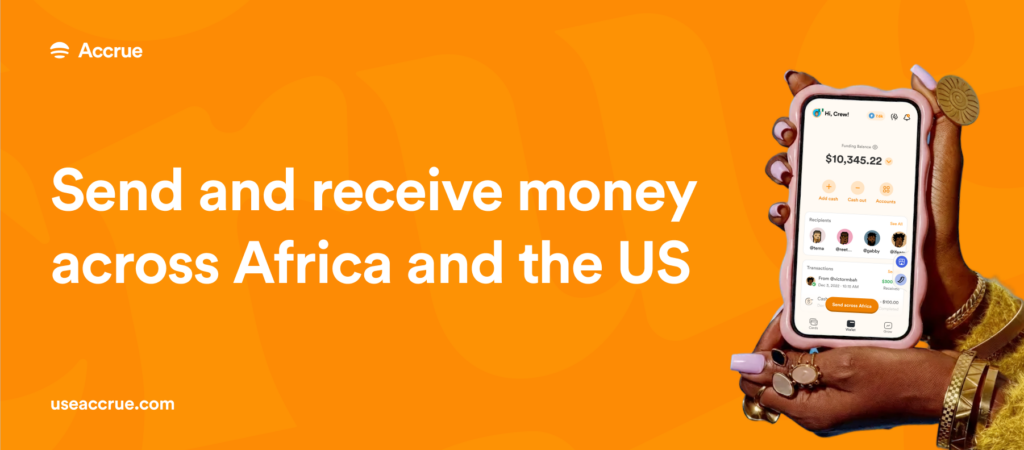
The Accrue Dollar Bank Account gives you a dollar account in your name, allows you to receive dollar payments from anywhere, and lets you withdraw seamlessly to your local bank when you need it. Create your Dollar Bank Account and enjoy seamless payment.

I’ve lived many lives, but one lesson ties them all together: money is only as powerful as its utility. Through my work, I share stories about money and create guides for Africans who want to get the best out of theirs.