
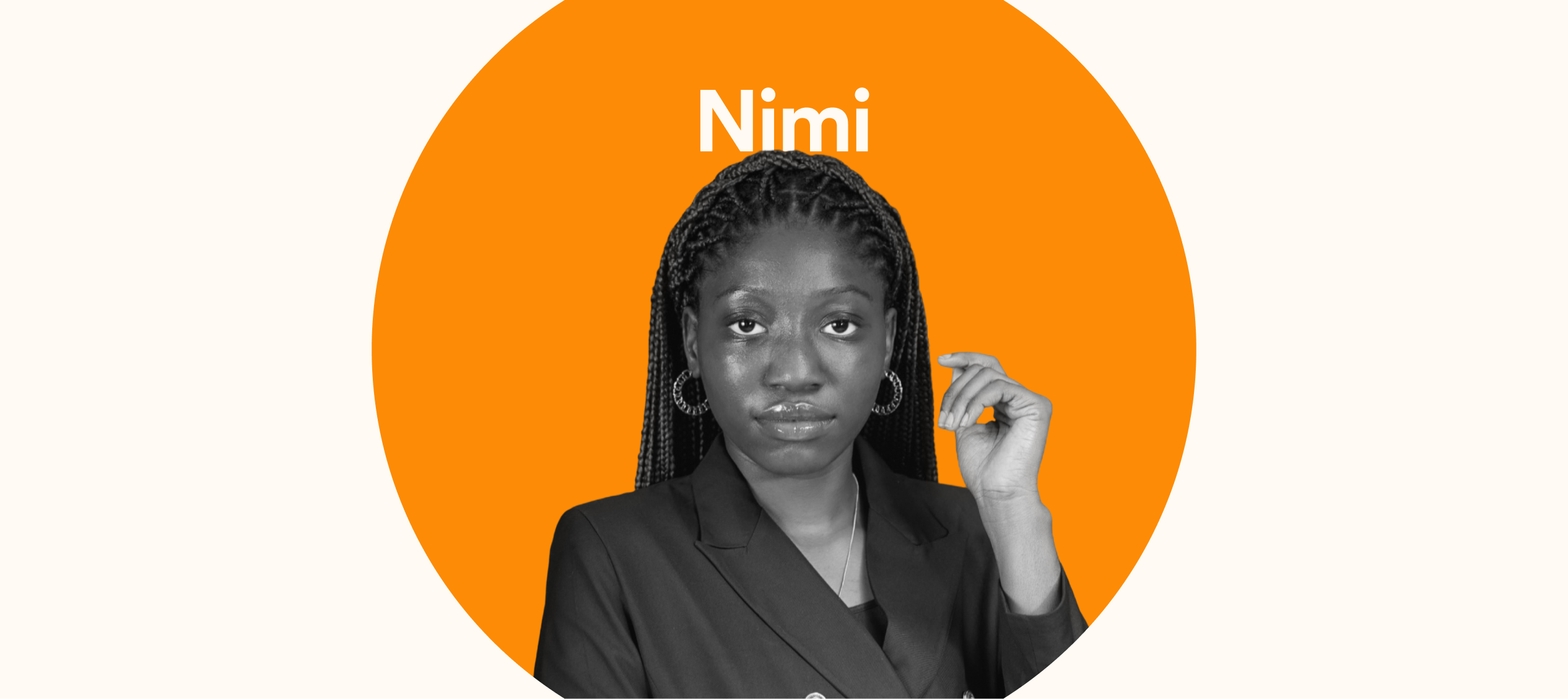
Nimi Oyekunle is a writer, marketer, and architecture student whose career has moved through creative writing, content writing, social media management, UX writing, and marketing. She started earning while in school, took on multiple freelance gigs, used her savings to buy a laptop, and is now positioning herself for a product marketing role while completing her master’s in architecture.
I sat with Nimi to discuss her first writing gigs, how she balanced school with work, the difficult transition into full-time employment, what she has learned about money, and what she is trying to build next.
Tell us, what was the first thing you did for money?
The first serious thing I did for money was creative writing.
This was in 2021, while I was still in school. I wrote a short story of about 10,000 words. Before then, I hadn’t really worked, so I wanted to try something new.
At the time, the money felt like a lot, even though looking back now, it wasn’t much. I think I was paid around ₦2,000 for that first story. After that, I started getting referrals. Someone would say, “This person paid me this amount,” and then the next person would offer something similar. The highest I got from that type of work was around ₦8,000, but it was a one-time thing.
Most of what I wrote then was fiction — romance, adventure, and stories like that. I read a lot of fiction, so writing it came easily to me.
What else were you doing around that time?
Around the same period, I got a social media management role.
It was in 2021, and they were looking for someone with little experience. I was earning about ₦50,000 per month, and I stayed there for around three months.
That was a lot of money for me at the time, especially because I was still in school. But I’ve always been a saver. I wasn’t necessarily saving for one specific thing; I just had the mindset that anything could happen at any time, so I needed money kept somewhere.
Most of the time, I saved about half of whatever I earned. I also had pocket money from my dad, and he usually sent everything for the semester at once because he knew I wouldn’t spend it anyhow. So I would calculate what I needed and keep the rest.
The money I earned from work became a backup plan.
What did those savings eventually help you do?
They helped me buy my laptop.
Some of the money stayed in PiggyVest and other savings platforms for a long time. I was jobless between 2022 and 2024, so those savings became my emergency fund. They also contributed to the money I eventually used to buy my laptop.
That laptop was important because by then, it was clear that prices were rising fast. I felt like I had to act quickly. It was either I suffered immediately by spending the money or I suffered later because the laptop had become too expensive.
How did you move from creative writing into content writing?
After creative writing and social media management, I tried content writing.
I worked with a writing agency where they assigned topics to different writers. The pay was not high, but it helped me build my portfolio because I was writing a lot. Sometimes I wrote up to three articles a day.
The process was straightforward: write, send to the editor, make changes, and move to the next article.
That was still in 2021, so at one point, I was doing multiple jobs at the same time. If I wanted to spoil myself, then I would buy shawarma. That was my reward system.
How much were you earning from the writing agency?
The agency paid about ₦1.50 per word.
For a 600-word article, that was around ₦750. If I wrote three articles in a day, I could make a little over ₦2,000. But I didn’t write every day because I was also studying architecture, and I didn’t always have the time.
In a good month, I could make around ₦15,000 from that work.
The topics were usually general topics — lifestyle, beauty, travel, and similar things. It wasn’t glamorous, but it gave me practice and helped me get better at writing consistently.
You also mentioned crypto writing. How did that come in?
That happened in 2022.
Someone from the writing agency reached out to ask if I could write crypto articles. At that point, I was open to trying almost anything. Crypto writing paid better than the general articles. I think I was earning around ₦2,000 per 600-word article.
But the process was long. You had to bid for articles, wait for them to be assigned to you, write them, and then wait for review. Because the review time took a while, you couldn’t move as fast as you wanted.
I probably wrote about six articles before I got tired of the process.
I also briefly worked with an Indian writing agency that paid around $10 per blog post, but that didn’t last because they were doing too much and I didn’t have the time.
Why did you eventually stop content writing?
I got burnt out.
There was one place where I was expected to write three articles every single day. Each article was about 750 words, and the topics started to feel repetitive. You were basically writing the same points over and over again.
There’s only so much your brain can produce under those conditions.
So around September or October 2022, just before the strike ended, I stopped. I later tried content writing again, but that period made me realise I needed to rethink what I wanted to do.
How did UX writing enter the picture?
I first heard about UX writing in 2022 through a friend who worked as a product designer.
At the time, I wanted something that felt more personal. Content writing felt like talking to everybody at once. Copywriting was more specific, but it still felt broad.
Because I’m an architecture student, I already think a lot about people and how they use spaces. UX writing felt connected to that. It was about helping people navigate a product, and that felt more purposeful to me.
It felt like an intersection of many things I cared about: writing, people, design, and usability.
Also, there weren’t that many UX writers around then, so it felt like a space where I could grow.
How did you get your first UX writing opportunity?
In 2023, Fullgap came to my school and sponsored an event.
There was a raffle draw, and the people picked had to pitch themselves to the speakers. The best pitches would win ₦100,000. I wasn’t very interested at first because I thought it was mainly for businesses, but I attended because I wanted to listen to the speakers.
Then my number was called.
We had only about 10 to 15 seconds to explain what we did and why it mattered in the context of the event. That was hard because not many people knew what UX writing was, so I had to first explain it and then make it relevant quickly.
I ended up being one of the people who won ₦100,000.
I used part of the money to fix my glasses, but the bigger thing was the visibility. I leveraged that moment a lot. I posted about the event, shared pictures, and even started a 30-day writing challenge to build momentum.
That visibility eventually helped me get a UX writing contract.
What was that first UX writing contract like?
I got the contract in July 2023.
It was supposed to be a three-month contract to work on a website and other UX writing-related things. I remember signing it on my way to a conference.
At first, things were going fine. Then exams came, and I wanted to take a break so I could focus on school. The founder told me to take a break and come back when the exams were done.
But when I returned, he said he no longer needed my services, and the contract didn’t continue after that, which forced me to rethink my next steps
You also did ghostwriting around that period. How did that happen?
Yes, I worked on ghostwriting for founders.
I got on calls with founders, alongside my employer, listened to their ideas, reviewed notes, and turned those conversations into posts.
It wasn’t an everyday thing. I think I was paid around ₦50,000 per month.
The process was very conversational. We would speak with a founder, identify different angles from the conversation, and turn those into posts.
How were you combining all of this with architecture school?
It was crazy, and it still is.
Architecture is very demanding. Every semester, we have a design project, and at the end of the semester, you have to submit and defend it.
What I used to do was work seriously from the beginning of the semester until about two or three weeks before exams. Once exams were close, I stopped working completely. After exams, I would return to work.
That was the only way I could give both school and work my best. I knew that if I tried to do everything at the same intensity at the same time, one of them would suffer.
What was 2024 like for you?
Honestly, 2024 was very hard.
It was my final year, and I didn’t do much paid work. I got a few website copy projects through a friend who works as a brand designer. When he worked on projects and needed a writer, he would refer me.
But apart from that, not much happened financially. I was mostly trying to survive school, final-year pressure, and everything else going on at the time.
It was a year where I felt like I was fighting for my life.
How did you enter 2025?
I entered 2025 just wanting to survive.
By then, I had started my master’s. The UX writing work from 2024 spilled into 2025, so I collected my full payment at the beginning of the year. But once that ended, I felt lost again.
I started questioning whether I was built for the path I was trying to follow.
Around that time, I had a call with someone in HR who gave me advice and helped me think through my options. I was also applying for roles.
Eventually, I got an offer from where I currently work.
How did you get your current job?
I applied for the role, though I wondered if I was the right fit because it seemed like they wanted a graduate, but the role didn’t require NYSC.
The process had three stages. First, there was an assessment. Then there was a case study interview. Finally, there was an interview with HR.
The case study interview was intense. We had both individual and group tasks. For the group task, they put about five or six of us on one call, gave us a scenario, and asked us to research, create slides, and present everything within the call.
I didn’t think I would get the job because there were many smart people in the process.
But I got the offer in June 2025 and started in July.
What has it been like?
It has been interesting, to say the least. I started out as a trainee in July, taking the role because I wanted corporate experience. I wanted to have an actual company on my CV, and I also hoped it would help me move into something more product-related.
And then as time went on, the team structure changed and my responsibilities increased. The program was supposed to run for six months, from July to December.
What happened after the six-month program ended?
At the end of December, I got a renewal contract.
I was offered a full-time role, and that kind of put my financial goals in perspective. Basically, I became much more realistic about what I could and could not do in 2026. Especially because I’m in the most financially intense year of my master’s degree.
But so far, the role has given me a great idea of the kind of skills I need to become the kind of professional I want and the kind of money I can get by upskilling.
What kind of roles are you trying to move into now?
I’m trying to position myself for product marketing or strategy-related roles.
I recently had a conversation with a product marketer, and it helped me realise that what I really want is to be in the middle of marketing and product. That was also why UX writing appealed to me in the first place.
I even interviewed recently for a product marketing associate role. The interviewer said I had a good portfolio, but I didn’t have the product experience they were looking for.
So now I know where the gap is. The challenge is figuring out how to build that experience while I’m still in my current role.
What salary range are you looking for?
Realistically, if I get a role that pays around ₦500,000, I would take it.
I know there are some numbers that may not be attainable yet, given my experience. But I’m at that point where I need to increase both my learning opportunities and my income.
What lessons have you learned from freelancing and full-time work?
One major lesson is that structure is sweet.
There’s something satisfying about knowing that, regardless of what happens, you’ll get paid at the end of the month. Freelancing money is not stable, so stability matters.
But working in a corporate environment has also taught me a lot about working with people. The stakes are higher. You have to communicate differently. Please avoid making statements without context, even when you disagree.
I’ve also learned that it’s important to be proactive about finding my own learning opportunities.
How has all of this affected the way you think about money?
It has made me more careful.
The dry spell I experienced changed me. I don’t want to go back to feeling like I have no options. So now, even though I’m earning, I’m always thinking about backup plans.
I save a lot. Sometimes I save half of my salary. But I also have things I want to do — buy things for myself, support people, improve my life. The only way I can do that without spending forever saving for everything is by earning more.
What’s next for you?
First, I want to finish my master’s before the end of the year.
After that, I still need to complete the process to become a registered architect. To become registered, you need your degree, your master’s or exams, NYSC, and then work experience under a certified architect.
Because I completed my master’s before the NYSC, the NYSC can count toward the required work experience. That was part of why I chose that route.
But at the same time, I don’t want to leave marketing or tech completely. Tech moves fast, and leaving the space for two years doesn’t sound like a good idea.
So the big thing I’m trying to figure out now is how to do both: continue the architecture path while still building my marketing and product experience.
It sounds intense, but that’s where I am.

I’ve lived many lives, but one lesson ties them all together: money is only as powerful as its utility. Through my work, I share stories about money and create guides for Africans who want to get the best out of theirs.