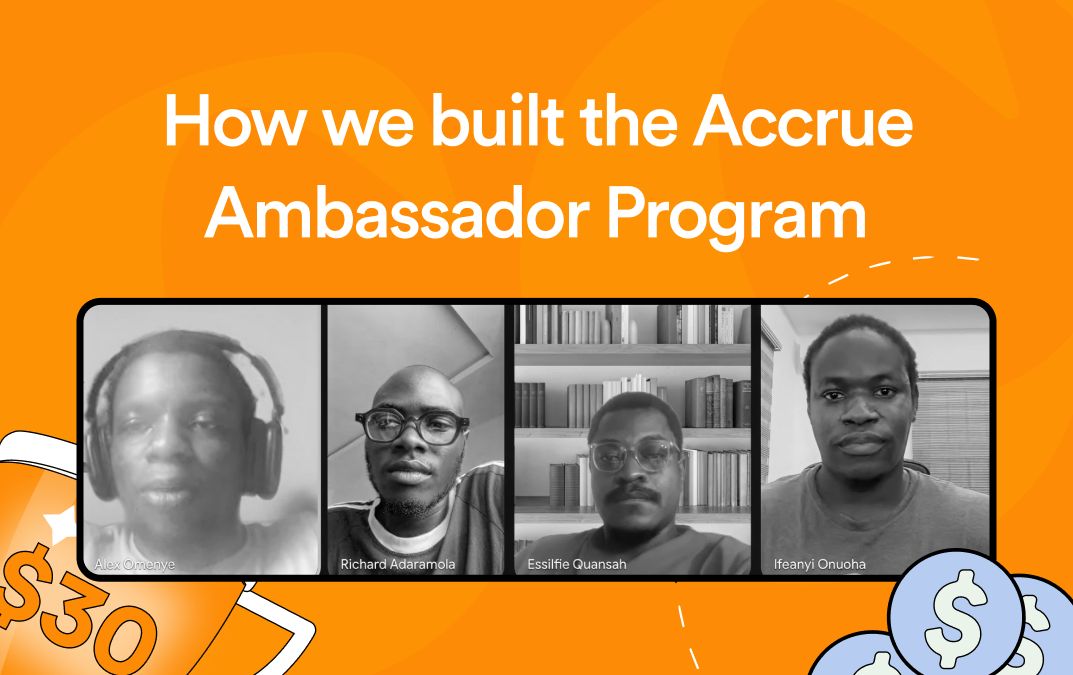


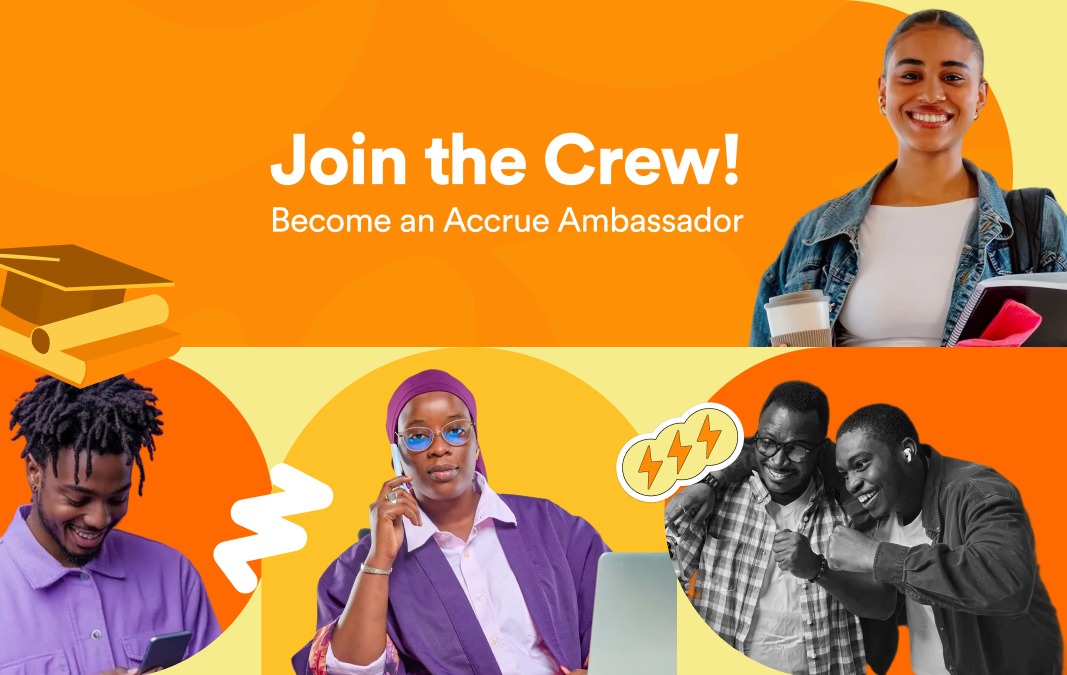

The Accrue Ambassador Program is live, and we spoke with team members who helped bring the project to life. The program was a referral into Accrue, complete tasks, climb leaderboards, and earn rewards in a way that feels transparent and easy to follow.
We spoke with Ifeanyi Onuoha, Essilfie Quansah and Richard Adaramola, the team, about the challenges behind the build, what changed during the process, and the lessons they are taking into future campaigns.

Can you walk us through your role in building the Ambassador Program?
Ifeanyi: My role was on the frontend side. The designs had already been created, and the backend work had been done, so I was responsible for bringing both sides together. I implemented the designs, integrated the backend data, and helped deploy.
Richard: I’m responsible for the look and feel of the Ambassador Program inside the app. Our work focused on making sure the experience was clear, easy to use, and aligned with how users would interact with the program.
Essilfie: I built the program’s backend. That meant setting up the logic to track the different actions users needed to take. Since ambassadors had weekly tasks, the backend had to check when a user completed an action that matched one of those tasks. From there, I used that data to calculate leaderboards, active referrals, and total referrals and make everything available through an API for the mobile app.
The Ambassador Program reused parts of the Christmas campaign. Was it as simple as adapting what already existed?
Ifeanyi: Not exactly. A lot of the lessons came from the Christmas campaign, but this was not a direct copy-and-paste project. Some of the challenges we faced during the Christmas campaign helped us avoid similar issues this time.
For example, with the Christmas campaign, there were features around sharing images and interacting with external platforms. Those platforms had their own rules and flows, and users did not always want to go through the extra steps. With the Ambassador Program, we avoided some of that complexity from the beginning.
Richard: At first, it sounded like we were simply reusing what we already had, but once we started looking more closely, it became clear that the Ambassador Program needed its own design thinking.
The tasks differed from those in the Christmas campaign. The reward system also needed to be reconsidered to better fit this program. We were not reinventing everything, but we had to adapt the experience to make sense for this specific campaign.
Essilfie: On the backend, we used the campaign scaffold from the Christmas campaign, but we still had to be careful. The Ambassador Program tracked different metrics, so the logic had to be adjusted accordingly.
What was the most challenging part of designing the experience?
Richard: One of the biggest challenges was the reward system. The Ambassador Program needed to reward people for genuinely bringing others into the app and helping increase Accrue’s reach.
That led us to rethink the leaderboard. We introduced two types of leaderboards. One showed the total number of people a user had invited, while the other focused on active referrals. That second part was important because we did not just want to reward sign-ups; we wanted to recognise users bringing in people who were actually engaging with the app.
Another challenge was figuring out how the program would coexist with Crew Coins. During the Christmas campaign, Crew Coins did not coexist with the campaign in the same way. But for the Ambassador Program, users can still earn Crew Coins normally while participating.
That meant we had to think carefully about entry points. The homepage already has a lot going on, so we did not want to bombard users with too many things at once. We had to make sure users could still find Crew Coins and also easily access the Ambassador Program.
What kind of user experience were you aiming for, Richard?
Richard: The main things were ease of use and transparency.
This is a program where users invite people into the app and expect to be rewarded. So they need to clearly understand what is happening. They should know how many referrals they have, where they stand, what rewards they qualify for, and how the process works.
If users are confused, they may reach out to support or lose trust in the program. So the experience had to make the reward journey feel clear and reliable.
How did the frontend implementation support that goal of transparency?
Ifeanyi: A lot of the user experience starts from design. Once the design team figured out where different pieces of information should live, the frontend work was about ensuring the data was displayed properly.
For example, the rewards were clearly visible on the leaderboard, both generally and for the current user. There was also more information available in different parts of the page, so users could understand how the program worked.
The goal was to make the important information visible enough that users did not have to guess what was happening.
Essilfie, what risks were you solving for on the backend?
Essilfie: The biggest thing was making sure the campaign didn’t break the existing referral flow, and during this campaign, we also changed how referral rewards worked, so I had to be careful. If there was a mistake, it could affect real money. For example, if actions were double-counted, users could receive rewards they were not supposed to.
That was one of the reasons I put guards in place. With backend work, especially when money is involved, small mistakes can have real consequences. So I had to make sure the referral system and reward logic stayed intact.
Were there any issues after launch?
Essilfie: Yes, there was a small issue we caught early, and because we had reused part of the Christmas campaign structure, a few areas had old tracking logic that hadn’t been fully cleaned up. After launch, I noticed that some actions were being double-counted. That made it look like some users were higher on the leaderboard than they should have been.
Thankfully, we caught it very early and cleaned it up quickly. After that, the calculations worked as expected. It was a small oversight, but it was a good reminder that even reused systems need careful review.
What changed the most during the design process?
Richard: The entry point changed a lot because Crew Coins and the Ambassador Program had to coexist; we needed to clean up how users discovered both. We had to make sure people could still easily find Crew Coins while also being able to access the Ambassador Program.

Another change was the prompt for joining the program. At first, the process was less seamless. Later, we decided it should be much easier for users to join. So we introduced a prompt that let users enter the program directly with a single clear action, simplifying the flow and reducing friction.
What part of the build did you enjoy the most?
Ifeanyi: Honestly, the fact that I did not have to do any drag-and-drop work this time.
The Christmas campaign had the Christmas tree interaction, where users could decorate the tree, move things around, and interact with animations. That was more complex. This one was more straightforward, so it was nice.
Richard: For me, it was the fact that we could reuse some parts of the Christmas campaign design, like the leaderboard and task page. We did not have to start from scratch with wireframes.
Of course, we still had to work on new things like the entry point and reward flow, but having a strong base made the process easier.
Essilfie: For me, the campaign tooling made the work enjoyable. The original campaign system was built to be flexible. I could mutate it and use it to create something different while still keeping the structure consistent.
That made the backend work feel more like plug-and-play in some areas.
Who or what made the work easier?
Essilfie: The documentation from marketing made the work easier by providing clear instructions on how the campaign should operate, how calculations should be performed, and what needed to be tracked.
The difficult part was also the documentation; at one point, I was working from the wrong document, but once the right information was clear, the actual setup was much easier.
Richard: For the design team, my colleague Tema made the work much easier. S/O to Tema. She did most of the design work, and I mainly provided input and reviewed what had been done. She helped make the process smooth for the team.

Ifeanyi: For me, the designs made the work easier. Once the designs dropped, I could clearly see what needed to be built. It was no longer this vague idea of copying the Christmas campaign. The design gave me a clear picture, and the implementation became straightforward.
What lessons are you taking into future campaigns?
Essilfie: Less assumptions.
Sometimes, when you write logic and test it, it feels obvious that everything will behave a certain way, but real users can use a product in ways you did not expect. E go shock you. Data can come in differently. Edge cases can appear.
For future campaigns, I want to make sure I cover more bases, especially around leaderboards, calculations, and rewards. If money is involved, the criteria need to be tight, and everything needs to be double-checked.
Richard: For me, the lesson is to keep building with quality and reusability in mind.
It might look like a campaign is just a one-time request, but you never know when the work will be useful again. If we had not designed the Christmas campaign properly, reusing parts of it for the Ambassador Program would have been much harder.
So the lesson is not to cut corners. A well-thought-out process creates value for the team later.
Ifeanyi: My lesson is that when marketing says something is copy-and-paste, it probably isn’t.
At best, this was maybe 50% copy-and-paste. I initially thought I would just remove anything that looked like Christmas and be done, but once the actual designs came in, it was clear this was a different experience.
Another lesson was around deployment. For this program, we shipped the feature early and enabled it via a backend toggle. That meant we did not have to wait for the app store review close to launch. When we were ready, we could simply turn it on.
That made the launch smoother.
The Accrue Ambassador Program is live. Join the program to have a chance to win $30 each week by completing tasks and topping the leaderboard.

I’ve lived many lives, but one lesson ties them all together: money is only as powerful as its utility. Through my work, I share stories about money and create guides for Africans who want to get the best out of theirs.