

Freelancing in Ghana is growing rapidly as more young professionals turn to online jobs and remote work to earn in dollars and other foreign currencies. With rising living costs, limited local job opportunities, and increased access to global platforms, many Ghanaians are building careers as writers, designers, developers, virtual assistants, and digital marketers.
In this article, five Ghanaians talk about their first biggest freelance paychecks, how they landed high-paying freelance clients, what it took to earn their highest online income yet, and how receiving that payment changed their view of freelancing as a career in Ghana.
Naa — Content Writer
Before that payment came in, freelancing felt like something I was constantly defending. Anytime someone asked what I did for work, and I said, “I write online,” the next question was always, “But what is your real job?” I stopped explaining after a while.
That night, I was still awake because my client was in Canada and their deadline was midnight. I remember sitting on my bed with my laptop balanced on my knees, rewriting an introduction for the sixth time, wondering how many times one person can rewrite the same paragraph before they start to resent words altogether.
When the payment notification of the $3,200 came in, my first reaction wasn’t joy. There was doubt. I checked the sender’s name. I refreshed the app. Only then did it settle in.
Three thousand two hundred dollars??? From writing???
That money didn’t magically fix my life, but it quieted something inside me. The constant anxiety. The subtle shame. The pressure to justify myself. For the first time, I wasn’t writing because I was scared of running out. I was writing because I have seen there’s a career out of it.

Kwame — UI/UX Designer, Kumasi
I didn’t grow up thinking I would work in tech. I just wanted work that didn’t drain me. When I started learning UI/UX design, it was because my job didn’t pay enough. I practiced after work, copying interfaces from apps I admired, hoping one day someone would actually pay me to do this.
So when a startup founder from Germany reached out, I assumed it would go nowhere because I'd had calls like that before, and afterward, they wouldn’t move forward because I was still an entry-level designer. I don’t blame them tho. The highest I have been paid for a job was $500 over two months. During our call, he spoke to me like he liked my work and earnestly wanted us to work together, and when he asked me what I would charge for the scope of work, I blurted out, $2000. His response was, “That’s within our budget.” I froze. When the first $2,000 landed, I didn’t celebrate. I just sat there. That amount was more than my monthly salary had ever been. Yet there it was, paid upfront without chasing.
That was the moment something shifted. I stopped seeing myself as someone trying to enter tech and began to see myself as someone who already belonged.
Abena — Virtual Assistant
For me, freelancing was my path to survival. I had an ailing mother who needed care, and so I needed work that didn’t force me to relocate, but most “proper jobs” came with conditions of relocation.
At first, the work was scattered. Small tasks. Small pay. Clients who assumed I was always available because I worked from home. I accepted everything because I didn’t know which opportunity would disappear next.
Then one client asked if I could take on a full operations role. When the $1,800 payment for the first month came through, I didn’t announce it to anyone. I was afraid that saying it out loud would make it vanish.
That paycheck didn’t make me rich, but it made me comfortable. I stocked up on food and medical supplies, upgraded my work tools, and started positioning myself for better opportunities. I learned a lesson from it. It taught me that stability doesn’t always come from one employer but from one good client.
Kobby — Video Editor
Editing videos started as something I enjoyed. It’s not something I took seriously enough to demand real money for so long; I undercharged because I didn’t know what was appropriate. I told myself consistency mattered more than pricing. I thought being grateful was the same as being valued.
Then I landed a long-term contract to edit YouTube videos. When the first full month ended, and $4,500 dropped into my account. I called my friend immediately because it looked illegal that video editing was paying that much. I was uncomfortable because I realized how long I had been shortchanging myself.
That payment forced me to confront the fact that the biggest limitation had often been my own mindset. Since then, I price differently. I negotiate differently. I work with more confidence.
Efua — Social media manager
People rarely talk about the waiting period. The months where nothing seems to move. Where you pitch, apply, post content, build case studies, and hear nothing back. Where you start wondering if you’re invisible or just not good enough.
I was deep in that phase when my biggest freelance paycheck of $2,750 came in.
There was no big reaction. I was on a trotro, scrolling absentmindedly, when I saw the alert. I didn’t scream. I didn’t cry. I just felt relief. Relief that the quiet months hadn’t been wasted. Relief that someone valued the planning, the strategy, the thinking that happens behind the scenes. The money gave me the confidence to keep showing up. $5K next!
A Four-Step Guide to Landing Clients Who Pay More
If you’re skilled, consistent, and still underpaid, the problem usually isn’t your talent. It’s how you’re positioned. This four-step guide shows how freelancers move into higher-paying work by being more intentional about how they attract and choose clients.

1. Upgrade Your Positioning
The first step to landing high-paying clients is positioning: clients don’t engage with skills; they engage with outcomes. There are thousands of writers. Thousands of designers. Thousands of developers.
Instead of saying: “I’m a graphic designer.” Say: “I help fintech startups design interfaces that increase user sign-ups.”
Instead of listing tools you know, describe results you create. Clients don’t care how many tools you use; they care about what changes after you’re hired: more sales, more time saved, fewer mistakes. This shift alone can double clients' willingness to pay.
2. Build Proof of Work
High-paying clients trust evidence. A portfolio full of random samples isn’t as powerful as: 2–3 case studies, clear before/after results, real client problems, and solutions. Even small projects count if you frame them properly.
3. Change Where You Look for Clients
To find high-paying clients, you may want to change from crowded platforms like Upwork and Fiverr. You will explore: LinkedIn, founder communities, startup networks, direct outreach, referrals, niche communities, Slack groups, and industry newsletters
Instead of competing with 300 freelancers for one job post, start positioning where clients are already building businesses.
4. Raise Your Standards Before You Raise Your Prices
Most people try to increase prices without changing their systems. High-paying clients expect clear communication, structure, processes, defined deliverables, and timelines. Money follows structure.
How to Get Paid Easily With Accrue
Accrue provides freelancers with a dollar bank account in their own name, making it easy to receive payments from clients anywhere in the world. Instead of worrying about payment delays or rejected transfers, freelancers can share their Accrue account details just like a regular U.S. dollar account and get paid directly.
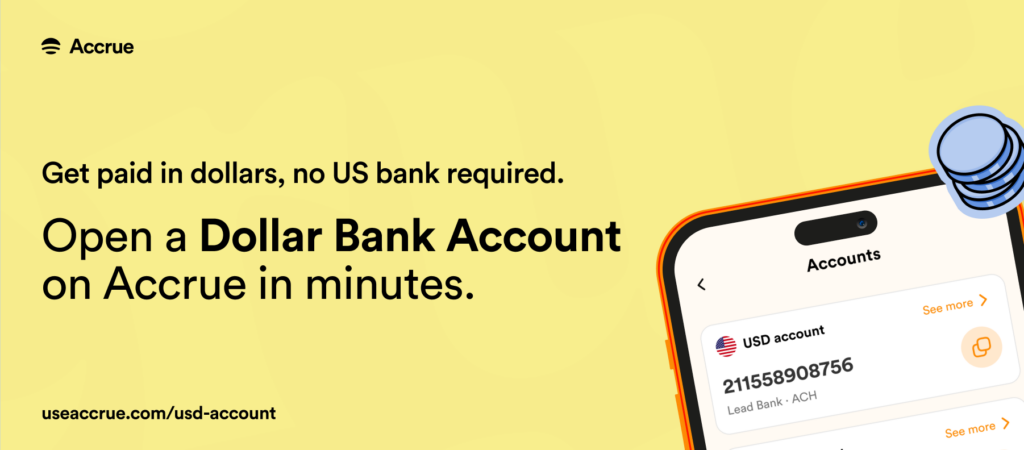
Once the payment comes in, withdrawing is straightforward. Funds can be transferred directly to a local Ghanaian bank account quickly and seamlessly. Accrue keeps costs transparent too, with a flat withdrawal fee of just $2, regardless of the amount withdrawn, making it easier for freelancers to keep more of what they earn.
Create a Dollar Bank Account with Accrue and start receiving dollar payments seamlessly