
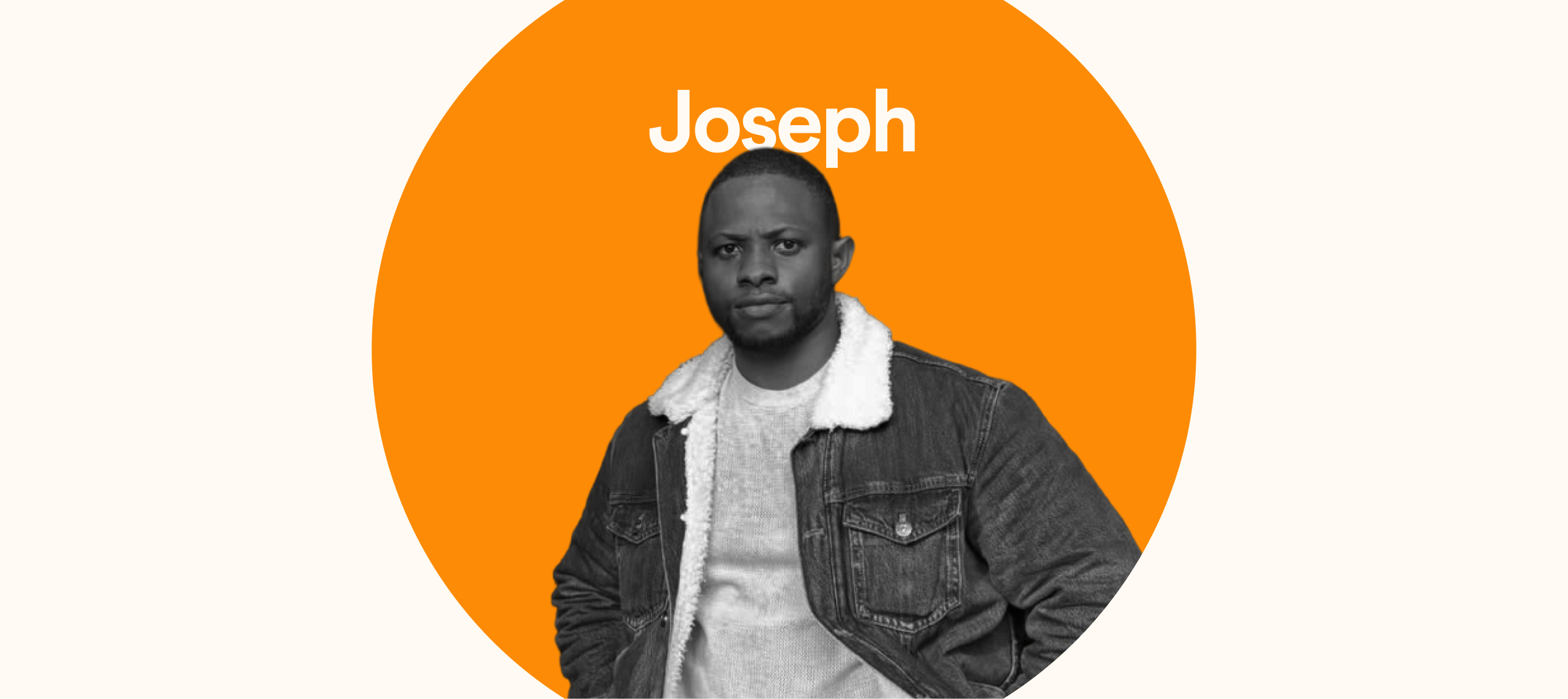
How Ayomide Joseph Built A Global B2B SaaS Career From Freelancing
Ayomide Joseph A. is a fractional marketing lead for B2B SaaS companies. His portfolio reflects projects with Aura, HYCU, Workvivo by Zoom, Teramind, Kustomer, Demandbase, and several others.
A quick look at his background shows that he started his freelancing journey by writing articles on Upwork and Fiverr and later, with finding his way into higher-value work by leveraging cold emails and social media to prove what he could do.
In this episode, I sat with Ayomide to discuss his earliest money memories, how he broke into B2B SaaS marketing, why he still sends cold emails, his nomad life, and how he thinks about money.
What was the first thing you did for money?
The first thing I remember doing for money was writing online articles back in 2015 or 2016.
Back then, there were people on Nairaland who recruited writers who would pay about 50 kobo or ₦1 per word. The pay was not great, but that was what was available at the time.
You would get topics like washing machines or dishwashers, and you had to research properly, watch videos, and write something good. There was no AI then, so you had to think through everything yourself.
If the article was bad, they could reject it, and you would not get paid. So you could spend days working on something and ultimately lose out if the quality was not good enough.
Do you remember how much you made from that?
It was based on how many pieces I wrote. If I wrote a 2,000-word article at ₦1 per word, that was ₦2,000. But you had to write several pieces before the money became meaningful. Sometimes, you would need to rack up to about ₦20,000 before collecting anything substantial.
At the time, the people outsourcing the work were probably earning in dollars, maybe $400 or $500, when the dollar was around ₦150. But for us writing locally, the money was small.
I was also in school at the time, studying applied geophysics, so I was navigating writing for scraps with schoolwork. Some months, I could do 10 or 15 pieces. It helped me learn how to type and think fast.
How did you move from those low-paying writing gigs?
After a while, I got tired of that kind of work. I tried Fiverr, but Fiverr did not really work for me. Then I moved to Upwork, and it worked a bit. I made my first $1,000 there in 2018 or 2019, but I also got tired because many clients were offering ridiculous rates.
After that, I started getting serious with social media. I became more active on Twitter and LinkedIn, and I started getting freelance gigs outside platforms.
I knew I wanted to do more business-oriented writing, so I started looking at companies and reaching out to people directly.
How did you start reaching out to foreign clients?
I started sending cold emails.
My mindset was simple: What do I have to lose? If I send an email to a CEO and they don’t respond, nothing changes. If they respond, that could change something.
The worst anybody can say is no. And when someone says no, I just move on. You only need one yes, and if the yes is big enough, it can overshadow a lot of nos.
I still send cold emails today. I sent one last week, and I will probably send another one today. People sometimes confuse being known with having everything figured out. Just because people know you does not mean you don’t still need to ask for opportunities.
Close mouths don’t get fed.
What was your first major break with foreign clients?
There were two early breaks.
One was with a social media company. The person reached out on Twitter, and we moved the conversation to Discord. He wanted me to write four pieces, and he was going to pay $750. Coming from ₦30,000 or ₦50,000 writing gigs, that felt huge.
I did that for about four months, but the client later got a new job and shut down the project.
The next one was a guy on Discord who needed pages for a product he was building. Short stints here and there, but nothing sustainable. Those experiences made me realise I could not keep doing random one-off work. I needed to focus.
What did you decide to focus on?
I decided to focus on software companies. I’d say largely because they had the budget to back up some of the ideas I had.
So to get in front of my target audience, I wrote a Medium article about how I helped a company get its first 100 SaaS customers. This was a lived experience taken from results I had gotten for previous clients.
The article did well, and someone reached out to me on Twitter after reading it. That became my first major US client, and I worked with them for about three years, until 2023.
You decided to become a nomad. When did that happen?
About two years ago. I had already been travelling before then, so I would not say moving from country to country gave me much of major culture shock. I have a strict routine that follows me everywhere, especially because of the gym and my diet.
These days, I navigate Europe. Spain is nice. Portugal is calmer. Poland has the best steak. But generally, the infrastructure is better, and things generally feel easier outside Nigeria (sadly).
Has becoming a nomad and living in Europe made it easier to get jobs?
I’d say yes. I mean, everything is easier away from Nigeria. I have lost serious opportunities because of location. Recruiters sort of zoom/google-meet run away when they hear you’re from the green-white-green.
There was one call where the person liked me and thought I was the perfect fit. Then he asked where I was from. When I said Nigeria, everything changed. He basically said he was sorry, but they could not hire from Nigeria.
But if you are in Europe or the UK, there is less friction. You are the same person, but the location changes how people perceive you (again…sadly).
What is the process for becoming nomad like?
Huh, I’d say easy or difficult is relative. I mostly move around. But taking Portugal as an example, if you meet the requirements, then it is straightforward. You need to show that you earn around €3,000 to €3,200 per month, and you need to provide bank statements, amongst other things.
The visa itself is valid for a few months, but after you move, you get a temporary residence permit. The first temporary permit is valid for two years. After that, you can apply for an extension, which can be valid for three years.
Moving on to work, what do you think separates good writers today?
I’d say taste. In a world where everybody can write, everybody can also write badly. AI has made the barrier to entry more complicated, so writing alone is no longer enough.
Taste is what separates people. You need to consume good creative work. You need to read widely. You need to understand what makes something good, what makes it human, and what makes people care.
I read a lot of Substacks. I like reading the work of people who can think deeply and put those thoughts into words. That kind of reading sharpens your own sense of taste.
What advice would you give someone who wants to become a B2B SaaS writer today?
Again, start by building taste.
Consume creative work. Read good writing. Then study the psychology of buying and selling.
I don’t think writing is the biggest problem. I think selling is the problem. You need to understand why people buy software products. And people buy software because they have a problem they want to solve.
When you understand the problem, the words become your way of showing the reader: “I understand what you are dealing with. This is the problem. This is what the problem can cause. And this is the solution.”
That is what good B2B writing does.
Is there anything you would do differently if you were starting again?
I would join a marketing agency early.
When you go solo, things you could learn in six months or one year at an agency might take you two or three years to learn by yourself.
In an agency, there is a strategist, an editor, a senior writer, and a whole team around you. When your work is not good enough, they correct it. You learn client management, delivery, timelines, strategy, and how the whole content system works.
You can start as a writer in an agency, move to content manager, and then content lead in three or four years. If you go solo, the same growth might take five or six years because you are figuring everything out alone while also trying to maintain your income and satisfy clients.
Some companies also prefer people with agency experience because of their familiarity in handling clients, deliverables, and timelines.
What do you spend most of your money on?
Travel and clothes.
I like travelling, and I also like clothes. Zara has collected a lot of my money. I like Chelsea boots, jackets, and things like that.
How do you think about money now?
For me, money is connected to work.
I don’t think about money first. I think money is a byproduct of work. If you can work, create value, and do something useful, money will eventually come.
That does not mean money is not important. It is. But I try to focus on doing the work well, asking for opportunities, and staying visible.
The universe will only give you what you ask for. If you don’t ask, you won’t get.