
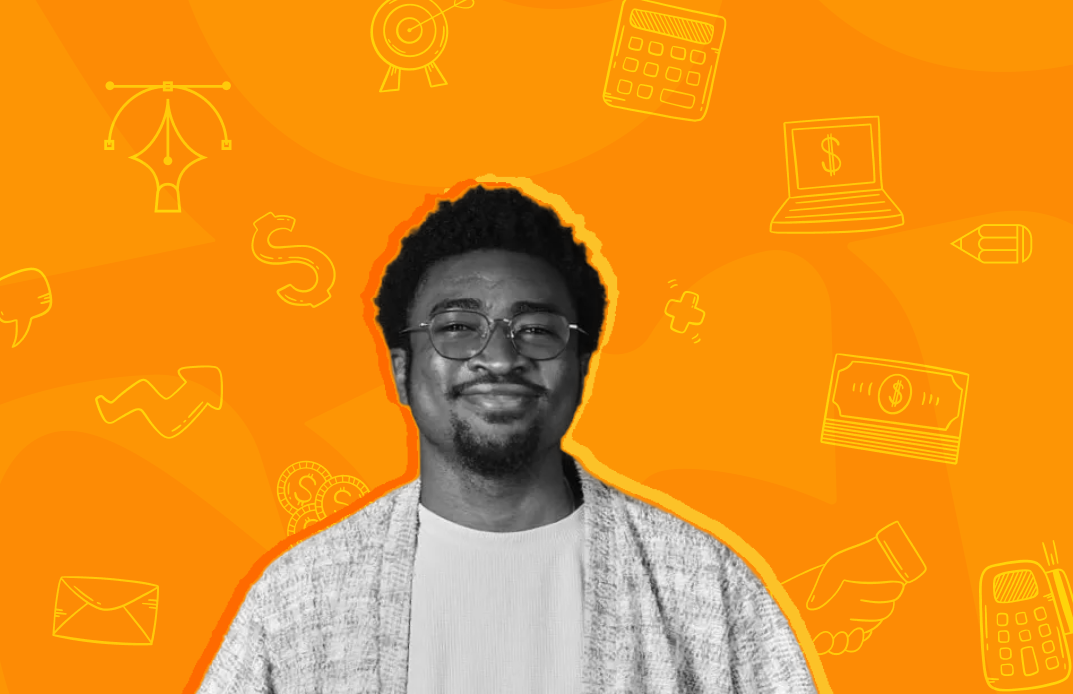
Shater Tsavsar is a product designer who started out as a developer and has built a design career through a mix of studio work, startup roles, and selective freelance projects. In this episode of Money Story, I sat with Shater to discuss how he found design, the projects that shaped his career, the reality of getting paid (and not getting paid), and the money habits he’s building as his income grows.
Tell us, how did you end up in product design?
It started earlier than I realized. In secondary school (JSS2), my school had a program in which schools presented student projects. That year, my school was presenting a website, and the ICT teacher, who was my friend, let me hang around. That was my first real exposure.
I remember a friend and I were learning small bits of HTML, and we started building a website called Twig. It was supposed to be a music pirating site. That was my first web-based project. The problem was: I was in boarding school, so access was limited to the ICT lab, and the internet was almost nonexistent. So the interest was there, but it was hard to grow it properly.
After secondary school, I studied Computer Science in uni, and funny enough, school made me hate code even more. I wasn’t doing well academically either, but then something happened: I had a carryover in a Java course and ended up in the same class with a guy who understood everything. Sitting with him made me feel like, “If someone else can get this, I can too.” That’s when the interest in building things came back.
Later, during an internship, I met Kingston, a product designer and the head of Friends of Figma Abuja, for the first time. I didn’t even know what a product designer was at the time. I just knew “developer” and “designer,” but over time, I noticed something: my design instincts were stronger than my coding. Eventually, my head of software noticed too, and they let me take on more design work while I learned. That was the start.
So, your first real work experience, how did that begin?
I got my first proper work experience through a mentor. Summer was coming, and I needed to do my IT later, so he connected me to a company running a summer internship program, Legend by Suburban, an internet provider.
I interned in the marketing team first. There was a stipend of about ₦15,000 and they also covered lunch in an interesting way. They had just launched a payments platform and used the interns to test it: we’d get daily funds (around ₦7,000) but could only spend them at places using their payment system. It was genuinely fun, but they still took tasks and deliverables seriously. One of my best early work experiences.
What was the first thing you did for money, ever?
Drawing comics in primary school is my oldest memory of making money outside of anything design-related. I was in primary 4, so around 2009/2010, and I was drawing comic books and selling them.
Do you think you have to be artistic to be a product designer?
Not necessarily, but I understand why people assume that. For me, creativity takes different forms. I’m more naturally creative with music than design, but I do think there’s something about curiosity, like hearing something, seeing something, and wanting to recreate it. That’s what drove me when I was drawing comics, and it’s also what drives me in design.
Some people think in shapes, color, and composition naturally. Others have that creativity elsewhere, writing, music, storytelling, and they bring it into product design differently. The outlet changes, but the “need to bring something in your head to life” is the same.
When did you start earning from design professionally?
My first paid design job was in February 2023, a freelance website and web app project for a content writing platform. The agreement was ₦100,000 (₦60,000 upfront, ₦40,000 after), but the company was chaotic and kept expanding the scope. I eventually had to lock the Figma file until they paid the balance. Worse: they still haven’t fully paid the developer friend I brought in to help.
That experience was an early lesson. I also did a couple of projects for a major fintech company, and they paid late, so late it felt like begging.
When did you get your first stable job?
Around July 2023, I joined a design studio called Bave. I initially wanted ₦100,000, but they offered ₦75,000, and I took it for stability. They later raised it to about ₦90,000.
Working there helped me build structure and improve my portfolio. Around the same time, I was also working on a mobile app project called Volla. I took it even though they couldn’t pay properly because I wanted my first app to go live on the App Store.
When did international work and “dollar-paying” work start?
October 2023. A client (David) hired me to design PDF Lawyer, a web platform for law students and lawyers that allows users to upload a contract and receive analysis and suggested changes. I was paid around ₦250,000 (the naira equivalent) for that work.
The bigger shift was early 2024. In February 2024, someone reached out after seeing my design in their mood board. That project paid $1,200 for about six weeks. It was for a ticketing platform called CrowdCue (it never really launched), but it was impactful: it helped me prove to my parents that design could be a serious career.

The first things I spent that money on were a better workspace setup (monitor, chair), a new phone, and some basketball shoes.
I can see that your career has been a story. What has worked best for you, applications or networking?
Honestly? Not applications. Most of my opportunities came from: referrals, people seeing my work online, DMs, and conversations that turned into offers
I’ve learned that a lot of hiring is… grace because whenever I apply the traditional way, it rarely works, but when someone sees my work and reaches out, things move faster.
At some point, I started tweeting more intentionally, sharing designs, what they were for, and how much a similar project costs. Those posts didn’t always go viral, but they did bring inbound leads.
The thing is, I don’t love the stress of freelancing and constantly marketing myself. I’d rather have a stable monthly income than chase clients.
Have your money habits changed as you started earning more?
Yes, mostly in structure.
I’m big on travel. I traveled a lot growing up, and making more money is partly so I can travel more intentionally. I already have a trip planned for later this year.
On money habits:
- I save aggressively. Once I get paid, about 50% leaves my account quickly
- 10% goes to tithes
- about 30–35% goes into savings/investments (depending on the month)
- I try to keep spending under ₦1,000,000/month, but real life happens (especially car expenses)
I’m also impulsive, so I prefer systems that remove money from my sight. I don’t mind ending the month with ₦10,000 in my account if my savings are intact.
For investing, I use mutual funds. I have an account manager there because I’m not deeply technical with investing. Over the last couple of months, returns have been roughly ₦300,000, and I typically put in around ₦1.2m–₦1.3m monthly. I also have friends who are more aggressive, buying stocks regularly—so I learn from them, even if I’m not as hands-on.
You should know about this rule for efficient savings and investing
What’s next for you?
I genuinely still love the work I’m doing at my current workplace. I’m not just clocking in and out. The work is meaningful, it stretches me, and I can see the impact of what I do. That’s important to me.
I’m grateful for where I am, but I’m also ambitious about where I’m going. I want to keep sharpening my skills, build new projects, and position myself for bigger opportunities. I don’t just want to be comfortable; I want to be evolving, and yes, I haven’t bought my BMW yet.
Read also about: The young Nigerian helping Nigerians invest in stocks