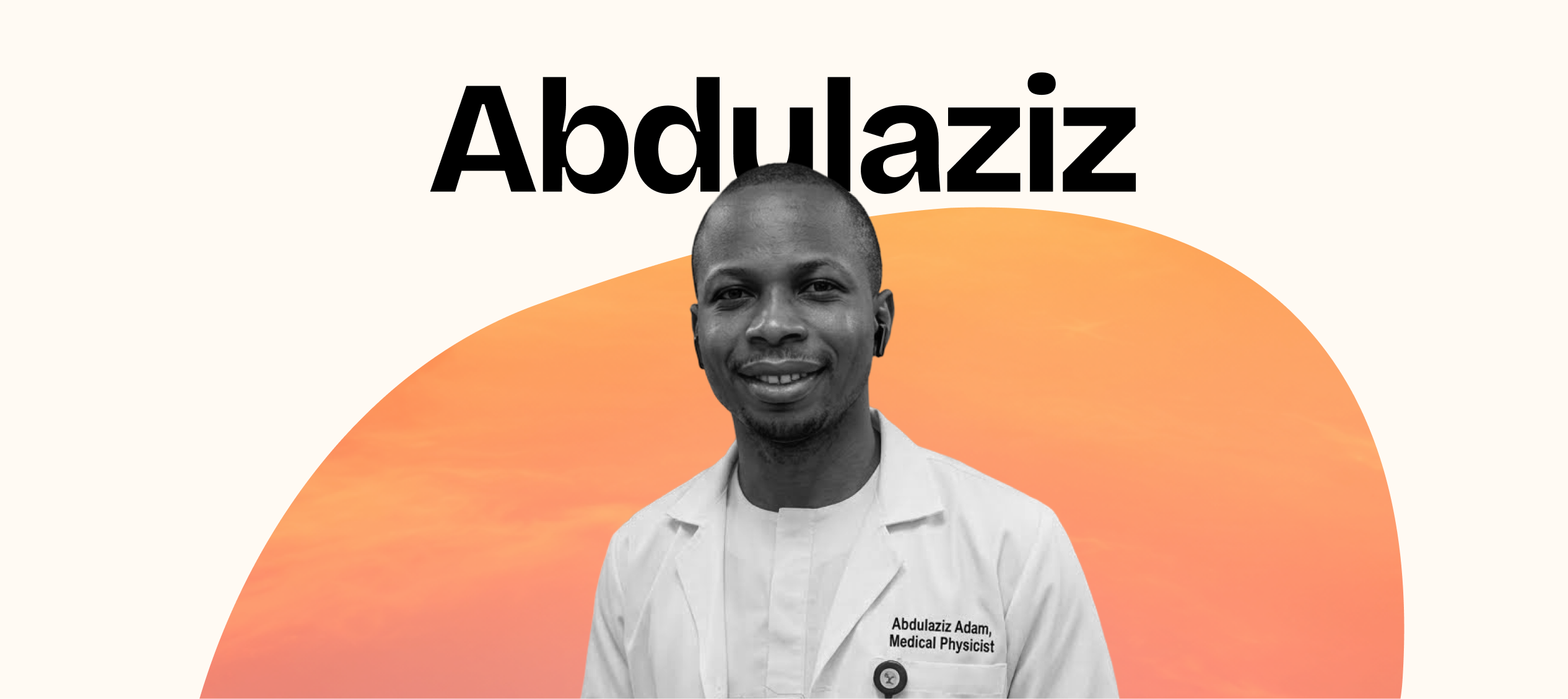
Nowadays, the orders usually arrive while Abdulaziz Adam is at work at a hospital in Kaduna, where he works as a medical physicist. When a notification appears on his phone, someone, somewhere needs money moved. An order needs fulfilling, and a customer paid.
Something about the contradiction feels fitting.
His professional life centres on things you can't see with the naked eye. As a medical physicist in a teaching hospital, he works with the physics behind medical equipment and treatment. His other work is similarly invisible. A customer in one country needs to be paid.
In both cases, people often notice the work only when something goes wrong, and when everything works, nobody thinks about the system behind it.
For Abdulaziz, that system has taken him from cryptocurrency trading while he was at university to becoming a Cashramp agent, and eventually to balancing the work with a career in medicine. He studied BSc Education Physics at Ahmadu Bello University, Zaria, graduating in 2023. Along the way, what began as an interest in peer-to-peer trading became something more practical: a way to help strangers solve a very ordinary problem.
How do you get money from here to there when the global financial system does not make the journey particularly easy?
A Cashramp Journey
Like many people who found their way into crypto in Nigeria, he came through peer-to-peer trading. During COVID and after, he became a merchant on Binance, learning the rhythms of buying, selling, and moving money between people.
Then the environment changed when Binance banned peer-to-peer operations for Nigerian users; merchants who had built businesses around the platform had to look elsewhere. Abdulaziz was in a group chat where people discussed this, and one day someone dropped a screenshot of another platform.
There was just one problem: nobody wanted to say what it was. He became curious. Eventually, while scrolling through Twitter, he saw another screenshot. This time, he asked the person who posted it what platform they were using.
The answer was Cashramp. He registered, completed the agent certification and then waited and waited. His application was pending for roughly three months, and he heard nothing. Instead of giving up, he went looking for the people behind the platform himself.
He searched for Cashramp on Twitter and began following the people the company followed. His thinking was simple: if these were the people the company was connected to, perhaps one of them could help him find his way in.
He messaged several people, and eventually, Clinton replied. Abdulaziz explained that he already had experience on Binance. He gave his email address, and that conversation eventually became his entry into the Cashramp agent network.
The Agent And a Medical Physicist
There is an easy assumption that someone who spends their time moving digital money must be doing it full-time.
Abdulaziz is not. He works in a teaching hospital in Kaduna as a medical physicist. The two jobs seem unrelated until you look more closely.
One concerns physics in a clinical environment. The other involves money, currencies, customers and digital transactions. One happens inside the formal structure of a hospital. The other happens through a network of people and technology that can feel much more informal from the outside.
Both require precision. A hospital has no tolerance for careless work, and neither does a customer moving a huge amount of money.
Since 2022, Abdulaziz has been effectively doing the agent work full-time. After getting a government job in 2025, he had to figure out how to make the two lives coexist.
The answer, at least partly, was automation. “The work is like a bit easy because there is like where you just deposit your [USDT] like that virtual account, that automation so you just remove it from my balance.”
He explains that things are easier now because agents can fund a virtual account, and incoming payments can be confirmed automatically. Instead of manually processing every transaction as he once did, he only steps in when an order requires something outside the automated flow.
Automation does not make the work disappear. It changes where the work happens. The agent no longer has to spend every moment watching for the next transaction. He can be in the hospital and still participate in a financial network that stretches far beyond Kaduna.
The phone is the bridge between the two.
Sometimes the Order Finds You
The strangest part of being an agent may be how little control you have over where you will be when the next order arrives.
For Abdulaziz, one of the most memorable orders came at a wedding.
The network had a problem, and a customer kept calling him repeatedly, trying to get his attention. Then he saw the size of the order. More than $2,000 in USDT.
“The network there was very bad. He was just disturbing me with calls, and it was really crazy. Then, at that time again, I saw the order; it was over 2,000 USDT.”
He wanted to complete it, but now there was another problem: he needed to find the necessary dollar liquidity. So, in the middle of a wedding, with poor network and a customer repeatedly calling, Abdulaziz started figuring out how to make the transaction happen.
Eventually, he did. He made the transfer.
It is a funny story when told afterwards, but it reveals something.
Money rarely waits for a convenient moment. People do not necessarily send money when the person handling the transaction is sitting neatly at a desk with good internet, a charged laptop and uninterrupted access to everything they need. They send money when they need to. You can be at a wedding, a hotel, while travelling and more often than not, at work.
The infrastructure has to work anyway, and that is where the agent becomes more than a person sitting behind an app. They become the human layer of a financial system. When the automated part ends, someone still has to make the judgement call, find liquidity, answer the phone, and get the money across.
The Ghanaian Tourist
Of all the stories Abdulaziz remembers, one is less dramatic than the $2,000 wedding transaction.
His name was Joshua. The Ghanaian had come to Nigeria as a tourist. He was travelling around the country and needed to pay for things along the way. The problem was straightforward: he did not have a Nigerian bank account.
So he used Cashramp. Hotel payments, food, transport and other expenses that come with moving through a country and instead of Joshua needing to figure out how to open an account or depend on a complicated chain of currency exchanges every time he needed to pay for something, Abdulaziz could make the local payments for him.
The arrangement became frequent enough that Abdulaziz remembers Joshua as someone who was “really clicking” with him, repeatedly coming back whenever he needed something paid for.
Money became the problem only because the financial infrastructure around him did not travel as easily as he did.
Joshua eventually visited around six Nigerian states, according to Abdulaziz. He even made his way to Kaduna.
A person in Ghana could arrive in Nigeria, travel across several states, and repeatedly rely on someone in Kaduna to make local payments for him, without the two ever meeting in person.
Their relationship existed almost entirely through transactions, and it is easy to think of cross-border payments as something that happens between businesses, banks, or financial institutions; while that’s accurate, it’s also a Ghanaian tourist trying to pay for dinner in Nigeria.
It’s Not All Rosy
Of course, moving money for other people comes with its own risks, and Abdulaziz remembers one customer in particular.
The person placed three separate orders. Together, they were worth more than ₦1.8 million, and then the user reported all three, and they were charged back.
For Abdulaziz, this was not a small inconvenience. It became a problem he had to take to his bank and resolve. A less glamorous side of being an agent.
An agent is trusted with somebody else’s money, and the customer is trusting that the person on the other side will do what they said they would do. The platform is trusting the agent to fulfil transactions. Banks and payment systems are involved in their own ways.
The whole thing works because a collection of people and systems repeatedly agree that the money should end up where it is supposed to go.
Abdulaziz’s Dream
Perhaps the most interesting thing about Abdulaziz's story is how ordinary the work has become.
He does not describe himself as someone who has built a grand career around moving money.
He is a university graduate who studied physics education, became interested in peer-to-peer trading, found a new platform, became an agent and eventually got a government job.
His next ambition is to launch a private over-the-counter desk.
It is a natural extension of the kind of work he has already been doing: facilitating larger, more direct transactions for people who need liquidity and execution beyond the standard experience.
That progression follows a certain logic. He started as a university student learning the mechanics of peer-to-peer trading. He became an agent. He learned what customers needed, what could go wrong, where liquidity mattered, and how much trust was involved in moving a transaction from one side to the other.
Now he wants to build something of his own around that experience. It is still money movement, but perhaps on a different scale.
This is what makes his story interesting. Not because Abdulaziz has abandoned one career to pursue another, but because the two seem to be growing alongside each other.
Physics taught him to think about systems that cannot always be seen, and money has taught him much the same lesson.
YOU WILL LIKE THIS: How Brian moves money from Nairobi to Enugu